

Don't Worry About Me
Or maybe we always should have worried about me? I don't know.

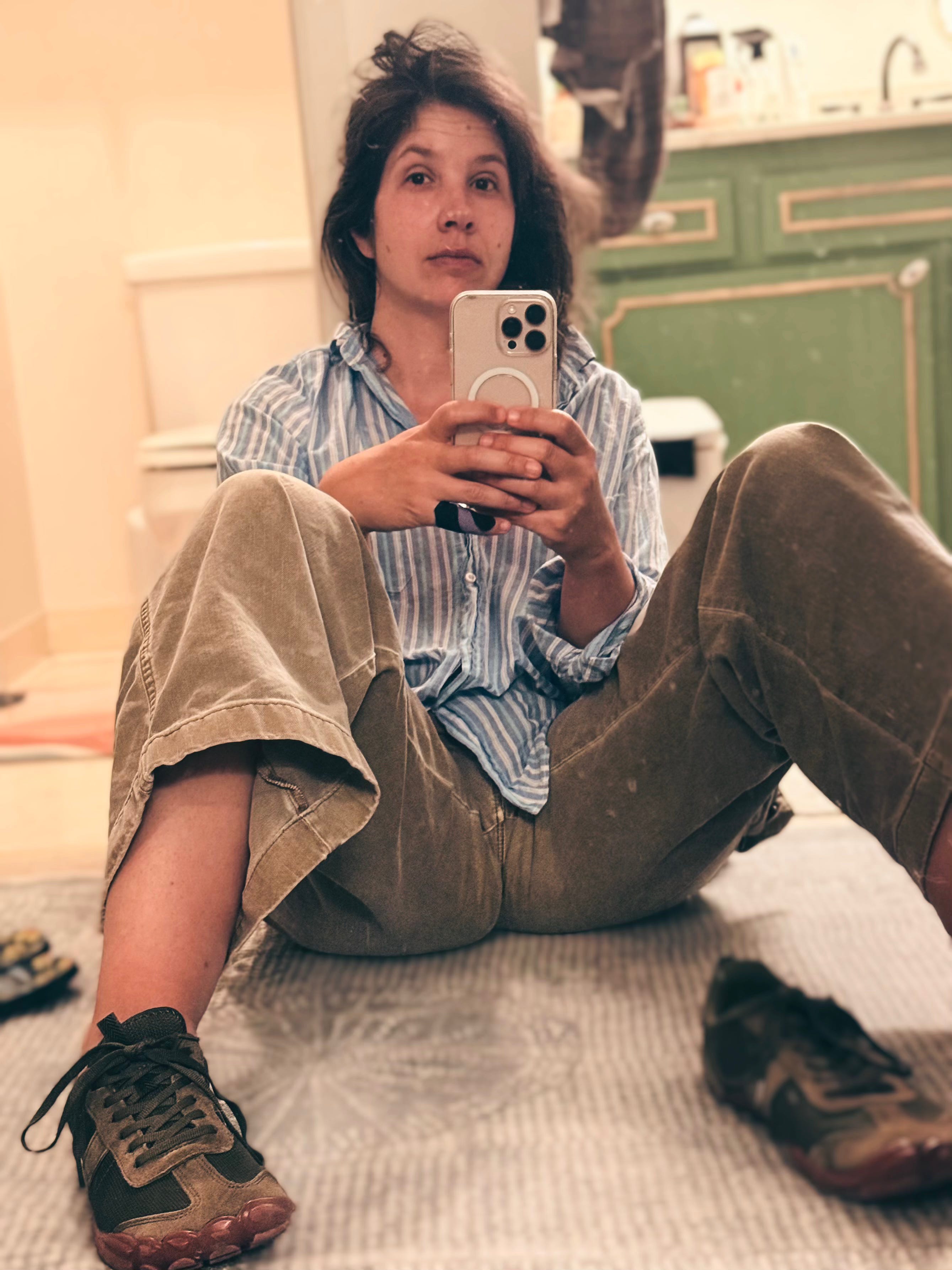
Last week I posted a photo of myself on the bathroom floor with the caption “Portrait of a woman who flamed out while putting her sneakers on,” and could immediately tell from the responses which commenters have dealt with ADHD and/or chronic illness—either in themselves or a loved one—and who has not. Because some people instantly got it, and some people were worried about me, or urged me to Get better soon! 1 And I realized that people without direct experience, don’t understand a whole lot about chronic illness, and also that while I talk about my ADHD sometimes, I don’t really talk about my chronic illness a whole lot (partly because I’m just coming to terms with it myself), which means that even if you have direct experience with me, it might not be clear. So here goes.
I’ve always been like this. Unless you knew me before grade school, you have never known me as a non-chronically ill person. In addition to ADHD, which I have always had, and a connective tissue disorder (hEDS), which I assume I’ve also always had, I have Mast Cell Activation Syndrome (MCAS), Dysautonomia/Postural Orthostatic Tachycardia Syndrome (POTS), and an unspecified autoimmune disorder (which could just be the MCAS talking, but not in a way that’s conclusive even after the billions of blood tests I’ve had). This seems like a million things to be wrong with a person, but it’s all interconnected, like a constellation of chronic illness.
When I was super young (six or seven), I remember having a cold and breaking out in hives and the doctor told my mother that sometimes when kids get viruses, they’re allergic to the virus and it causes hives. No one seemed all that concerned and the hives went away as the virus waned. Not long after that, I developed asthma and allergies, but no one put any pieces together around that. For the next forty years, I would periodically have completely bizarre and unexpected reactions to foods, fragrances, pollen, plants, clothes, temperature changes, and my own sweat, then go for more allergy testing and only test positive for an IgE allergy to dust mites, but none of the other things I was certain caused hives, or wheezing, or made my tongue swell up. I was always tired. I blacked out for a moment almost every time I went from sitting to standing, or after climbing to the top of a flight of stairs. My feet throbbed if I had to sit at a desk (grade school was hell for so many reasons). I felt dizzy if I had to stand still. My stomach always hurt after eating. And even when I was in the best shape of my life, I could never run at anyone else’s pace (faster or slower than mine) without feeling horrifically nauseous, breathless, and disoriented.
Because I was so young when all of this started, I thought these things were simply the basic experience of having a human body, and that everyone else was just less whiny than me. And in all honesty, I always thought foodies were exaggerating. How could anyone actually enjoy food when they knew that post-meal stomach pain was on the way?
The first true crack in my awareness wasn’t until six or seven years ago. I was complaining to a friend about having to make a dentist appointment, but I was waiting for copyedits that would come with a tight deadline, and didn’t have a clear idea of my schedule for the next few weeks. She didn’t understand why I needed a big picture understanding of my life circumstances to make an appointment that would, at most, take 3 hours, including travel. I explained that I’d probably feel awful for days after, struggling with jaw pain, headache, nausea and exhaustion.
“So wait,” I said, “you just, like, go to the dentist and then go on with your day?”
She did. The commitment of a dentist appointment for her was simply the time it took to go to the dentist.
I started wondering how many things that I found exhausting weren’t exhausting to other people. Not having an understanding of my disabilities beyond having ADHD, I chalked it up to my neurotype instead of my body and decided this was an ADHD thing—like the stereotypical “joke,” that a 3PM appointment ruins a whole day for someone with ADHD, even though I also had physical symptoms. I felt bad for being so easily rumpled by life. All I’ve ever wanted was to be rugged, but if a simple dentist appointment was a major commitment for me, and wasn’t for other people, it meant I was clearly the opposite of rugged.
As a kid, I was always getting hurt—turning my ankle, spraining my wrists, bruising my tailbone, displacing my ribs, getting air trapped between my lungs. In high school, I had to have major orthopedic surgery after the muscle in my thigh contracted while I was lying on the couch, ripping the cartilage in my knee. I spent nine months on crutches. I threw my back out as frequently as a middle-aged man who forgets to lift with his legs. Again, I somehow attributed all of this to being worse at human-ing than everyone else. Turns out I had a connective tissue disorder.
In 2024, when I was finally diagnosed with MCAS (because certain diagnostic tools useful to my diagnosis had finally become available2) I was prescribed a mast cell stabilizer and all of a sudden the weirdest thing happened when I ate food.
“My stomach feels like nothing,” I said to my husband.
“What do you mean?” he said.
”You know how your stomach hurts after you eat?”
No. No. He didn’t know.
I asked a friend if her stomach always felt like nothing after she eats. It did.
“I’m so glad you have nothing stomach now too,” she said.
I was forty-seven years old when I learned that your stomach isn’t supposed to feel like it has been folded in half too many times and stomped into submission after every meal, that black tea doesn’t give everyone the sensation that their internal organs are being turned inside out and flipped upside down, and that if bananas make your blood pressure plummet, it’s not just that you don’t like them because they make you feel funny, it’s that you’re having an anaphylactic reaction, even if you don’t test as being allergic to bananas on a skin prick or blood test.
Turns out when too many things trigger my MCAS, everything starts to trigger my MCAS. At one point, I ran out of the house, unable to breathe, head spinning, vision going black, because of the smell of food Jeremy was cooking. I had an anaphylactic reaction to food someone else was planning to eat3.
Turns out, stress is an MCAS trigger too.
Turns out, I also have POTS. My blood volume is low and my heart and mind are kind of out of sync when it comes to moving that blood around my abnormally stretchy body. So simply going from seated to standing can cause my heart rate to jump 30-40 bpms. Eating sends a lot of blood to my stomach, away from my brain, and standing still, or sitting in a chair with my feet flat on the floor means my blood starts pooling in all the wrong places. I’d rather walk seven miles than stand in line at the grocery store, which makes absolutely no sense if you don’t have an understanding of POTS.
So, now I take a beta blocker when my POTS is flaring, eat an abnormal amount of salt, and drink water like it’s my primary purpose in life. My POTS gets worse when my MCAS is flaring, so managing MCAS is also part of managing POTS. The way my Dystautonomia doctor described it sounded like a horoscope. Some people’s POTS symptoms are worse than their MCAS symptoms, but I’m basically an MCAS with a POTS rising.
And all of this causes a lot of pain. But because I’d never not known some version of that pain, I was very good at disconnecting from my body. Much of the time, I didn’t carry awareness of pain, only the exhaustion that was the result of being a person who walked around in pain all the time. When I was first diagnosed, I became suddenly aware of just how much my body hurt and it felt like the onset of the flu, a creeping ache taking over on a cellular level. I wanted to cry, but worried if I started I’d be crying out forty years of hurt. Thankfully, treating my MCAS helps treat the inflammation that causes the pain, because it turns out that painkillers are a huge MCAS trigger for me too.
So, actually, I’m a pretty rugged MFer, because I’ve been dragging myself through everyday life in the forty-some-odd years since that virus that made me break out in hives, without even realizing that other people just eat food and breathe air and walk around in the big smelly world and go to the dentist like it’s nothing because they’re not flirting with ruin all the damn time. Once on Threads I saw a post that said something to the effect of how when you’re a chronically ill person, you’re also the caretaker of a chronically ill person. Which means that in addition to having a fluctuating health condition, I also have the extra burden of being the caretaker of this weird and often wonky body, and I’ve managed to keep myself going this far, which is no small feat.
Everything I’ve accomplished in my life has been while managing my constellation of conditions. And while I think over the years, that constellation has added a few stars and possibly gotten a little brighter, I’m better at managing my chronic illness issues now that I have diagnoses, medications, and an understanding of the need to pay attention to my body instead of constantly pushing myself past my limits. A really wise friend with chronic illness said to me once that they don’t actually mind talking about their illness, but they worry that other people will decide for them what they can and cannot do. They want to be the only judge of their abilities, so they tend to keep it on the down low. And I understand that, because I’m terrified of someone else placing limits on me. I have limits, but so does everyone. I also have a whole bunch of tricks to accommodate myself. With my life-long chronic illnesses, I have written five books, converted yards to gardens using only hand tools at two different houses, single-handedly sold and packed up a house in Rochester to move cross-country to California4, raised and trained four dogs, and even ran up a mountain once on a whim.5 Everything I do has a cost that chronically healthy people don’t have to calculate, but it’s my math, not yours. And I also have the benefit of never expecting to be comfortable. Something I’ve come to appreciate about myself (while also realizing I have to be more mindful about) is that I have a spectacular tolerance for discomfort. I don’t ever expect to feel good. Do you know what an incredible power that is (when wielded responsibly)? Not only does it make me really tough, it also means I’m really good at appreciating small, simple things.6
I’m not going to get better soon, or ever (barring some kind of miraculous scientific breakthrough). My conditions are chronic, not curable. Some of them are basically woven into the fiber of my being. The best I can hope for is management. I’m alright with that, because I’ve never known otherwise. Management is a bonus. I’m happy to have names for the specific things that are wrong with me (as opposed to everything) and an understanding of what foods I can eat and products I can use without breaking out in a rash so severe that urgent care will think I have measles and make me go through a special door to the exam room so as to avoid an outbreak (turns out I can’t eat strawberries, and have to use newborn detergent to wash my clothes). And while there’s still some lack of predictability built into my experience of having a body, the fluctuating nature of my conditions means that I have really good days mixed in with the bad, and easier seasons, not just difficult ones. I cling to good and easier with all I have, and I’m grateful, but I know from the outside that my inconsistency is confusing. She hauled a gazillion yards of mulch around her yard and dug up the lawn with a broad fork, what do you mean she’s chronically ill? Well, Sheryl, that was on a good day.
My whole life has been a process of recovering from things. Prior to diagnosis, I would beat myself up relentlessly, because my fluctuating health and energy felt fake to me too—like something I must be doing on purpose. Laziness. Lack of motivation. Forget the fact that I’ve written five books, and done a bunch of other projects that required a truly impressive level of self-motivation and discipline. A down day (or series of days) after a week of extreme productivity would leave me muttering “Get the fuck up and do something, you piece of shit,” to myself, while I felt glued to the couch, barely able to muster the energy to find a tv show to watch. When something big was on my schedule, I’d watch the date creep closer, nervous about how I’d feel, believing the state of my body was as random as the numbered ping pong balls pulled from a bingo cage. I’d pack my schedule and then crash hard the second I had a free moment. I’d knock myself out spending energy on other people, not understanding that my energy debt was far greater than that of most of the people I was pouring effort into helping. When we talk about energy, we’re all operating with different rates of currency, and I think we have to start having more serious conversations about the cost of effort, how it varies, and how to weigh that when bartering with each other for time and attention. Because the way we talk about effort in our current culture is incredibly small-minded. If they wanted to, they would, is ableist bullshit. If wanting was all it took, my life would look very very different.
One of my primary goals is to not get worse. My collectors pack of chronic illnesses were most likely was all kicked into gear by that hive-inducing virus. Over the years, it’s likely that other viruses shifted my issues into higher gears. Post-viruses, sometimes, I got better, sometimes I accumulated symptoms that stuck around, or only faded a little bit. The October before Covid hit, I had a respiratory infection7 that sent my body into a tailspin, took ages to recover from, and triggered a loss of tolerance for a wider range of foods. As much as it sucked, that virus made me very aware of how careful I needed to be about Covid, even prior to gaining a fuller understanding of post-viral illness and prior to my diagnoses. I know sickness = symptom amplification for me, so I’m going to do everything I can do avoid sickness.
But you have to live your life…
Avoiding things that will make me worse is living my life. I eat a very limited, careful diet—which is not disordered eating, it’s necessity. I mask in public indoor spaces and avoid crowds. Since it’s likely that a virus kicked off my issues, and many of the issues I’m dealing with are also components of what people with Long Covid struggle with (the post-viral illness in me honors the post-viral illness in you), it is my personal mission to never get another virus again if I can help it. I’m in Reddit and Facebook groups with people who were completely fine for their whole lives—with nothing stomachs and normal heart rates—until they got Covid, and now they have MCAS so severely that they can only eat two or three foods under very specific conditions and/or have POTS so badly that walking the length of their apartment is the heart-rate equivalent of doing a 100-yard dash while carrying an anvil.8
While I have a lot of ups and downs (often many cycles during any given day), I still have about twenty safe foods and a little bit of leeway to eat some other foods in moderation. On a terrible, horrible, no-good, very bad day, I can still usually walk the dogs for a mile or two, which is a huge level of health privilege that I greatly appreciate. On a good day, I can easily hike 5-7 miles on hills, or do my extreme landscaping projects. I’m even hopeful about getting back to running at some point. I appreciate the quality of life I have with every ounce of my tachychardic heart. I know I’m extremely fortunate for the health I do have, and I’m not keen to mess it up by raw dogging some rando’s germy breath, eating a banana, or using scented hand lotion. Because even when I crash out while putting on my sneakers, as long as I am able to keep the health I have, I know eventually, I’ll get that other shoe on. I’ve always had days like this. I’ve never known life without days like that. And I’ve always done it anyway. I’m not whiny. I’m actually really fucking rugged.
Everyone was so well-intentioned and I totally appreciate the care in all of those statements
My MCAS doctor told me that the tests he used to diagnose me had only become available two years prior. While MCAS had been diagnosed in people prior to that, I personally probably could not have been diagnosed all that much sooner than I was
This also happened again the day after I wrote this. (I’m okay)
Jeremy had to go to California ahead of time for work
During that best shape of my life season
This is, of course, only my very specific life experience. Since I didn’t know any better, I don’t have the same sense of loss as someone who dealt with an onset of disability later in life, and I still have a great deal of health privilege. I am not at all saying that my chronic illness is a super power or that we should see anyone’s disabilities as an advantage, etc.
I don’t think it could have been COVID, the timeline doesn’t work out, but I have researched the timing over and over and over again and discussed with several doctors.
This is also why I wish you would mask. I interact with people suffering from Long Covid on a daily basis. Every Covid infection increases your risk of Long Covid — not getting Long Covid the last time you had Covid doesn’t mean you won’t get it next time. If you like doing things like eating and standing up without passing out, please consider masking.
You have beautifully put into words what so many of us have lived, without invoking pity. Awareness is a powerful thing. Rock on fellow rugged badass. 🔥🎸🔥
Different flavors for me, but I know this place.
Honestly, the past two years have kind of cracked something open. I’ve been white-knuckling this idea that I can just perform normal. Keep up, push through, look fine. And I’m finally at a point where I’m like… I can’t keep holding that mask up. It’s exhausting and it’s not honest.
So I’m trying to do this thing where I actually accept my limitations instead of fighting them, and figure out what a genuinely joyful life looks like from where I actually am.
Thank you for writing this. Seriously. It matters. And you are not alone. ❤️